The Result
The Result
The project resulted in Value propositions, mobility personas and a handover of user study results n the shape of a needs and requirements list and a summary of user study data. Further details might be published in a report from Whim in 2021.
The project resulted in Value propositions, mobility personas and a handover of user study results n the shape of a needs and requirements list and a summary of user study data. Further details might be published in a report from Whim in 2021.
Reflections & Improvements
Reflections & Improvements
I find it important to reflect upon executed projects to evaluate my work and finds way of improving my work. One reflection I had on this project is that we narrowed down our target group too late which led to a very wide scope. Also, we found using mediating objects as being very helpful in this project but used them in a very late state of our progress which is something I bring to my next project. As well, we started our designing of Value propositions quite late after gathering and analysing the data. This lead to the iterative and evaluation phase of the design being short. Overall, I am very proud and happy with the work done in this project but of course, there are improvements to be made.
I find it important to reflect upon executed projects to evaluate my work and finds way of improving my work. One reflection I had on this project is that we narrowed down our target group too late which led to a very wide scope. Also, we found using mediating objects as being very helpful in this project but used them in a very late state of our progress which is something I bring to my next project. As well, we started our designing of Value propositions quite late after gathering and analysing the data. This lead to the iterative and evaluation phase of the design being short. Overall, I am very proud and happy with the work done in this project but of course, there are improvements to be made.
Project overview
Project overview
Process
The process of data collection, (figure further down on the site) was initiated with theoretical research with the purpose to generate insights from existing research. The theoretical research was followed by market research to create an understanding of active actors but also map potential aspects where current service providers are insufficient. The theoretical research and market research was also complemented with discussions with industry experts that have unique insight into MaaS. The process of understanding the users was initiated alongside theoretical research, market research and discussions with industry experts (figure further down on the site).
The process of data collection was initiated with theoretical research with the purpose to generate insights from existing research. The theoretical research was followed by market research to create an understanding of active actors but also map potential aspects where current service providers are insufficient. The theoretical research and market research was also complemented with discussions with industry experts that have unique insight into MaaS. The process of understanding the users was initiated alongside theoretical research, market research and discussions with industry experts.
Understanding the users was initiated through planning of the users studies which fueled the following steps. The following steps were: recruitment of users and screening of users.
The data generated by the user studies has been analysed through coding, then derived into user needs and requirements which then fueled the initial formulation of the value propositions.
Process
The process of data collection, (figure further down on the site) was initiated with theoretical research with the purpose to generate insights from existing research. The theoretical research was followed by market research to create an understanding of active actors but also map potential aspects where current service providers are insufficient. The theoretical research and market research was also complemented with discussions with industry experts that have unique insight into MaaS. The process of understanding the users was initiated alongside theoretical research, market research and discussions with industry experts (figure further down on the site).
The process of data collection was initiated with theoretical research with the purpose to generate insights from existing research. The theoretical research was followed by market research to create an understanding of active actors but also map potential aspects where current service providers are insufficient. The theoretical research and market research was also complemented with discussions with industry experts that have unique insight into MaaS. The process of understanding the users was initiated alongside theoretical research, market research and discussions with industry experts.
Understanding the users was initiated through planning of the users studies which fueled the following steps. The following steps were: recruitment of users and screening of users.
The data generated by the user studies has been analysed through coding, then derived into user needs and requirements which then fueled the initial formulation of the value propositions.


The Brief
This project was conducted as part of a Business Design course at Chalmers University of Technology.
The brief was to develop a business design based on an identified problem, in other words - very freely create a business in a quite conventional way. The brief was to execute a situation analysis, create a market offer with segmenting, positioning and competitive advantage strateg. Furthermore the team was expected to do a marketing plan containing the six P:s: Product, Pricing strategy, Place, Promotion, People and Physical evidence. Last the team was expected to do a sales forecast and an action plan.
The Result
The issue -The business opportunity
Many cities are poorly designed for the private transportation of goods. People living in a larger city are often limited to solutions such as taking the bus, bicycling or walking due to city planning that does not favor driving. This is a limitation that affects their ability to transport goods such as weekly food-shopping or furniture.
Using a car in an urban environment has several issues such as rush hour, limited and expensive far off parking as well as the negative impact on the environment. A trendy solution to this issue is the transportation of food to the customer’s doors, such as Mathem, which exists in bigger cities. These solutions, however, are limiting since the customer has to be at home for an extensive period to receive the delivery, does not get to choose the food themselves and is often more expensive.
The business mission is to provide a convenient, flexible and accessible solution for people to transport goods in an urban area.
The business idea - Vecta
The need resulted in the concept called Vecta - a new product and service system. The product is an electric cargo bike with a built-in lock. The bike is sold to housing companies where their customers can use and book the bikes through an app, also provided by the Vecta service team. The Vecta service is convenient to use since it’s located next to the customer’s house, does not require maintenance and involves no personal risks of using for the customer, for example, it does not matter for the customer if the bike breaks or gets stolen. The customer avoids the big investment of around 20 000 to 50 000 SEK an electric cargo bike requires.
Furthermore, Vecta will offer the housing companies a competitive edge in the shape of an attractive transportation alternative to their potential tenants. The bikes will be a great alternative for housing estates with limited space where car parking is hard to find and is especially well suited for housing companies with a focus on sustainability.
"The purpose of the business is to provide a simple, flexible, accessible and sustainable way for people to transport goods in an urban environment. The business will be a combination of a product and a service that enables simple and efficient transportation of ungainly goods for the customers without much effort."

Project overview
Main methods used
-
Survey for potential customer
-
Interviews with potential partners (housing companies)
-
Service blueprint
-
Formulate a business mission
-
Situation analysis
-
SWOT analysis
-
Segmenting, targeting and positioning
-
Market offer design through the 6 P:s
-
Action plan design
-
Formulation of Sales forecast
Target group
The targeted market segment is households that belong to a housing agency located in a city. They do not have the option to or do not prefer to use a car but can afford and physically use the product.
Positioning
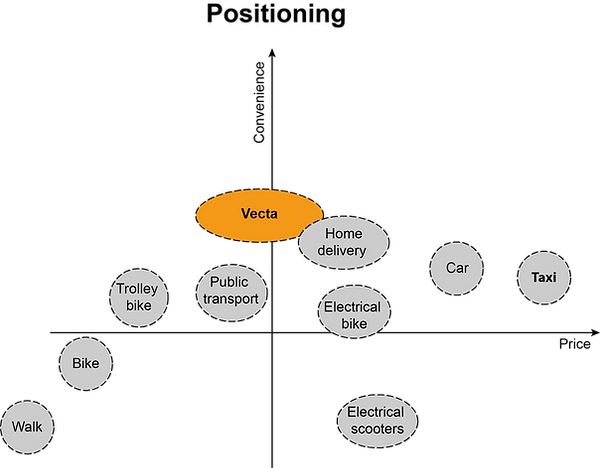
Vecta position itself as a service more easy to use than public transport and at least as simple as having your own electric bike or getting the groceries to your door through delivery services such as Mathem.
The target group is the people who find problems with simplicity and efficiency in the competing companies. To able to compete with the other companies, and especially cars which is the main competition, Vecta needs to not only be simple but to be an affordable alternative, since the simplicity aspect in that case might be questionable. Vecta is, therefore, positioning itself in a price range between taking the bus and owning your own cargo bike, see figure 6. The simplicity should be as good or better than having your own cargo bike and get your groceries delivered to your door.
Competitive strategy
Vecta’s competitive strategy is focused on differentiation. Its differentiation advantage relays on being simple, flexible, accessible, reliable and affordable. Simple because the service requires no maintenance and since the service is easy to use and is an easy way of getting from A to B and back to A whilst carrying goods. Ownership of for example a bike or a car requires time-consuming maintenance, which is sometimes unexpected as well as costly. The service is easy to use since its got a simple, straight forward use: The customer books the Vecta, picks it up at the booked hour from the customer’s yard, returns it back outside the customers’ house again.
By taking a Vecta the customer avoids traffic jams and problems with finding a parking spot since the customer uses the bicycle roads and parkings. Vecta is flexible since the customer can use the bicycle any time it’s not booked. The customer can book the bicycle 24 hours a day, with no added cost for example nighttime use. Compared to other options there is basically only the ownership of a car that can compete with that flexibility. The Vecta is found outside the customers’ house and there are always enough bikes to satisfy the customers’ needs, which makes it accessible.