The Result
The Result
The project resulted in Value propositions, mobility personas and a handover of user study results n the shape of a needs and requirements list and a summary of user study data. Further details might be published in a report from Whim in 2021.
The project resulted in Value propositions, mobility personas and a handover of user study results n the shape of a needs and requirements list and a summary of user study data. Further details might be published in a report from Whim in 2021.
Reflections & Improvements
Reflections & Improvements
I find it important to reflect upon executed projects to evaluate my work and finds way of improving my work. One reflection I had on this project is that we narrowed down our target group too late which led to a very wide scope. Also, we found using mediating objects as being very helpful in this project but used them in a very late state of our progress which is something I bring to my next project. As well, we started our designing of Value propositions quite late after gathering and analysing the data. This lead to the iterative and evaluation phase of the design being short. Overall, I am very proud and happy with the work done in this project but of course, there are improvements to be made.
I find it important to reflect upon executed projects to evaluate my work and finds way of improving my work. One reflection I had on this project is that we narrowed down our target group too late which led to a very wide scope. Also, we found using mediating objects as being very helpful in this project but used them in a very late state of our progress which is something I bring to my next project. As well, we started our designing of Value propositions quite late after gathering and analysing the data. This lead to the iterative and evaluation phase of the design being short. Overall, I am very proud and happy with the work done in this project but of course, there are improvements to be made.
Project overview
Project overview
Process
The process of data collection, (figure further down on the site) was initiated with theoretical research with the purpose to generate insights from existing research. The theoretical research was followed by market research to create an understanding of active actors but also map potential aspects where current service providers are insufficient. The theoretical research and market research was also complemented with discussions with industry experts that have unique insight into MaaS. The process of understanding the users was initiated alongside theoretical research, market research and discussions with industry experts (figure further down on the site).
The process of data collection was initiated with theoretical research with the purpose to generate insights from existing research. The theoretical research was followed by market research to create an understanding of active actors but also map potential aspects where current service providers are insufficient. The theoretical research and market research was also complemented with discussions with industry experts that have unique insight into MaaS. The process of understanding the users was initiated alongside theoretical research, market research and discussions with industry experts.
Understanding the users was initiated through planning of the users studies which fueled the following steps. The following steps were: recruitment of users and screening of users.
The data generated by the user studies has been analysed through coding, then derived into user needs and requirements which then fueled the initial formulation of the value propositions.
Process
The process of data collection, (figure further down on the site) was initiated with theoretical research with the purpose to generate insights from existing research. The theoretical research was followed by market research to create an understanding of active actors but also map potential aspects where current service providers are insufficient. The theoretical research and market research was also complemented with discussions with industry experts that have unique insight into MaaS. The process of understanding the users was initiated alongside theoretical research, market research and discussions with industry experts (figure further down on the site).
The process of data collection was initiated with theoretical research with the purpose to generate insights from existing research. The theoretical research was followed by market research to create an understanding of active actors but also map potential aspects where current service providers are insufficient. The theoretical research and market research was also complemented with discussions with industry experts that have unique insight into MaaS. The process of understanding the users was initiated alongside theoretical research, market research and discussions with industry experts.
Understanding the users was initiated through planning of the users studies which fueled the following steps. The following steps were: recruitment of users and screening of users.
The data generated by the user studies has been analysed through coding, then derived into user needs and requirements which then fueled the initial formulation of the value propositions.

CO-CAR - A startup project exploring mobility needs and carsharing in Gothenburg
Chalmers, 2020
The Brief
The brief was connected to an entrepreneurship course where we were supposed to gather a team and simulate creating a startup. We decided to work with the issue with the car dependency in urban areas where car ownership is challenging.

The Result
"The idea started with a question, does everyone need a car? After some brief research we realized that the answer is most likely no."
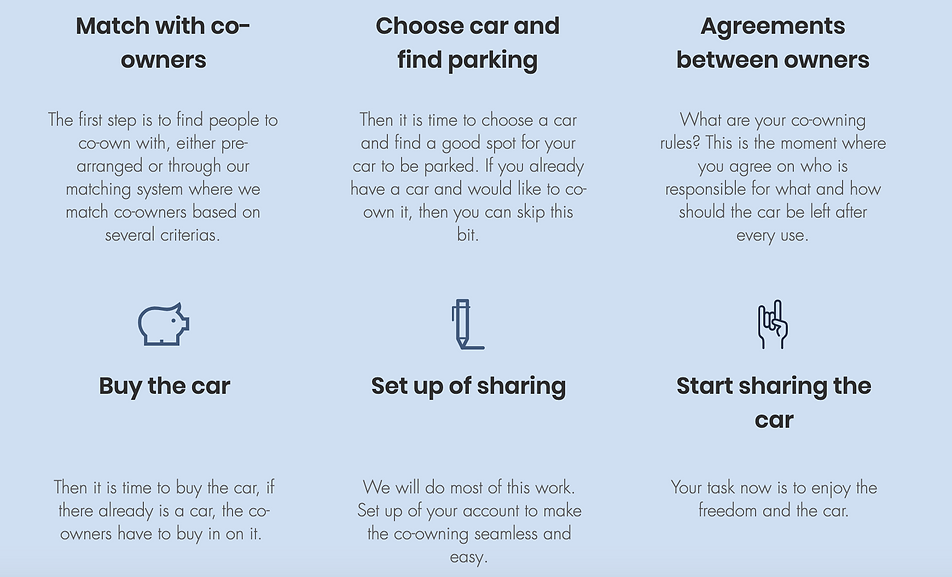
The idea is to enable seamless co-owning of cars. The reasons for this are that privately owned cars are unused 95% of the time, the current options for carpooling are not flexible enough and it is rather expensive to own a car by yourself. Reducing the number of cars is also beneficial from an environmental perspective. To enable seamless co-owning of cars consists of 3 main pillars:
1. Enabling and providing access to a network of potential co-owners to team up with we help the customer to find a match.
2. Taking care of those boring, but necessary things, like a structured scheduling- and booking system and contracts.
3. CO-CAR ensure the customer gets access to related services through a network of maintenance and insurance partners, key to keep our customers on the road!
The initially targeted group is the younger generation, primarily utilizing other mobility services as their means of transport. This segment mainly resides in urban and suburban areas with proximity to the city center. This group values sustainability and are aware of how their behavior impacts quality of life at a small scale, as well as climate change in the world from a higher-level perspective. Our vision is that through enabling seamless co-owning of cars, we can reduce the number of cars on the road, offer a worry-free experience of owning a car and access to a car at an attractive price.
Project overview
Following are descriptive figures of the service blueprint for entering, using and exiting the service, the competitor analysis, and price benchamarking, the persona for the initial target group,
.jpg)
.jpg)
.jpg)
.jpg)
.jpg)
Reflections & Improvements
If I was to redo this project, or continue working on the startup, I would work faster to get a MVP out and evaluate the business model more with potential users.